Friday, August 21, 2009
Wednesday, August 5, 2009
End of summer travels
The last time I wrote, my break from classes had just begun. As of yesterday, summer is officially over, and it’s back to university life for me. I spent much of my vacation in Bogotá, preparing for a salsa competition that took place in early July. Our group, Afrolatina Salsa Show, took third place out of sixteen groups with our fifteen-minute piece entitled “El gringo.” The storyline behind the show is that a foreigner (me) arrives to Colombia hoping to learn salsa. Our choreography featured different styles of salsa as well as monologues by yours truly in an exaggerated gringo accent. The show brought a lot of laughs from the hundreds of spectators at the event. Once the video gets up on YouTube, I’ll make sure to post a link.
In mid July, my girlfriend, Paula, got back from volunteering in Peru, and we left Bogotá to explore other parts of Colombia. We decided to head to the Pacific coast, in the department of Chocó, which is much less developed than the Caribbean coast. Chocó is still a conflict area, though the coast is safe given the presence of a military base. However, due to both the conflict and, more importantly, the fact that Chocó is essentially covered by rainforest, it is impossible to arrive by land. For that reason, we had to take a tiny plane—only 15 passengers when full—from Medellín to Bahía Solano, Chocó, and from there hitch a ride on a jeep to a small fishing town, El Valle, about forty-five minutes away.
El Valle is one of the most beautiful places I have ever seen. It is essentially ocean, beach, and rainforest, with nothing in between. The endless stretches of beach are essentially vacant, as El Valle is visited by relatively few tourists; Paula and I often had kilometers of beach to ourselves. Two hours south of El Valle on foot begins Utría National Park, which protects vast areas of jungle and mangrove swamps. We had an opportunity to hike in the park with a local guide—necessary given the lack of defined trails. Unfortunately, the guide did not alert us to the length of our journey (nine hours) nor did he encourage us to carry any more the dry crackers and salty cheese. Despite my hunger, I still finished the day feeling quite the jungle man.
In contrast with our rainforest trek, the rest of our time in coast was quite relaxing. Many days we spent at the beach—boogie boarding, reading, or visiting a random bar located on the beach overlooking the ocean. We also had the opportunity to go back to Utría, this time in boat. We spent the afternoon at an island that is part of the park and snorkeled by reefs close to shore. I was lucky enough to see an enormous sting ray in addition to loads of brightly colored fish. We spent the boat ride back to El Valle whale watching. Whales from Antarctica migrate each year to the area, many of which can be observed from shore during peak whale watching time. Although we were there at the beginning of whale season, we were able to see one whale…though from quite a distance.
It was hard to leave El Valle, not because of the greatness of the place (though true), but rather the lack of transportation in which to leave the area. We had planned to take a cargo boat down the coast to Colombia’s largest port, Buenaventura. Locals commonly travel on boat if they need to leave the area, and I was determined to prove I could hang with the best of them by surviving a 24-hour trip in a boat not designed for passengers. Unfortunately, three days in a row the boat’s departure was delayed until the next day. On the third day, after having spent more money than planned in lodging and food, we decided to fly back to Medellín, a luxury that cost us little money and saved us a lot of time.
From Medellín, we continued on to Cali, where we visited Paula’s extended family, went out, and nursed our sunburns. I returned to Bogotá on Sunday in order to start classes. A quick trip to the Caribbean coast this weekend will end a summer of relaxation. I have less than four months left before I head back to Iowa, which is bound to greet me with snow and freezing cold temperatures. I plan to take advantage of my remaining time by visiting as many warm places as possible…and will do my best to post about the latest happenings as they occur.
Saturday, June 6, 2009
'Terror scarf'?
Some of you may remember last year’s controversy that followed a Dunkin Donuts ad in which Rachael Ray appeared wearing a scarf that resembled the Arab keffiyeh, or hattah. Led by blogger Michelle Malkin, who called the keffiyeh “a regular adornment of Muslim terrorists appearing in beheading and hostage-taking videos,” conservatives pressured Dunkin Donuts to remove the ad, which the company did, much to the chagrin of Arab-Americans. It is true that the keffiyeh became associated with the Palestinian resistance movement in the 1960s and had been strongly tied to the image of Yasser Arafat. Yet, to many Arabs across the Middle East and in the rest of the world, the keffiyeh is nothing but a traditional headdress worn by men to protect from sun exposure and blowing sand.
Strangely, the keffiyeh, or palestina as Colombians sometimes call it, has become a fashion item in Bogotá in the last few years. People of all ages and classes wear keffiyehs as scarves, without any political consideration at all. You can find palestinas in every market across the city, mixed in with traditional artisan goods. The only person who has ever commented on my wearing of one was an Israeli backpacker, who asked, isn’t that an Arab thing?(Interesting final note: Jews also commonly wore keffiyehs until the first Intifada.)
A busy end to the spring semester
My first semester at Los Andes has finished, and incredibly I’m halfway through my time in Colombia. Classes ended well, and I feel I got quite a bit out of them. My class on the history of the Colombian armed conflict has given me a good overview of the past century in Colombia, and the professor of the course shared many great stories from the various peace processes he has been involved in with different guerrilla groups. A second class, on the theory of armed conflict, was a downer, as professors Tom Cruise (one looked like Tom Cruise) and Kung Fu Panda (the other like Jack Black) failed to deliver on what could have been an interesting course. Our class on negotiations and peace processes was my favorite and made me realize that I’m most interested in the role the international community can play in the development of peace in internal conflicts—a good interest for me to have, I suppose, given the unlikelihood of an armed conflict in the States.
During the second half of the semester, I grew closer to many other students, as our time together extended from the classroom to the social arena. Close friends include: David, who hails from Pasto, the most ridiculed place in Colombia; Raimondo, an Italian whose greatest love is reggaeton; Sophia, the group’s go-to photographer for all social events; Juan Felipe, member of two rock bands, one called Dandi Yonquis that sings completely in English; Juan Ricardo, who recently exposed us foreigners to traditional Colombian music during his birthday celebration; Laura, my partner in crime at the concert of La 33, Bogotá’s most famous salsa band; Mariz, socialist and dancing feign; Carlotta, a Spanish student who recently became my neighbor; and Daniel, another Spaniard who could easily pass as a Colombian—sans the accent—after having spent eight years here.
Old friends also have graced the scene as of late. Priyanka, Margaret, and Jayne, all of whom were with Anthony and me in Cuba in 2006, came to visit a couple weeks ago. Anthony and I enjoyed giving them a tour of the city we presently call home. We sampled Colombia’s most important legal export at various cafes; visited the Botero museum; danced at a variety of clubs, ranging from the Moulin Rouge-esce Andres Carne de Res to the decades-old local hotspot, Goce Pagano; ate fabulously both in my new neighbor and at Restaurante Casa Antonio Dest; and climbed—ok, went by cable car—to the top of Monserrate, the peak that overlooks the city. We also had a chance to leave the city to visit Villa de Leyva, a colonial town five hours outside of Bogotá, where we hiked around waterfalls, went horseback riding at night, and hung out in town’s enormous plaza.
My friends’ visit was over before it started, only to be followed by a visit from my girlfriend, Paula, en route to a Nourish International summer in Peru. I continued to perfect my skills as a tour guide, and the weather even cooperated for the second week in a row. In addition to general exploring, we had a chance to see Son de Cali in concert and host a house warming party at my new apartment. All went well in the latter, excluding the lack of chairs, which left a number of people on the floor. Oh well, yet another reason Colombians should show up on time!
Paula left a few days ago, and I have been playing catch-up since. More post should follow soon…
My new home
A few weeks ago I moved to a different neighbor about a 15 minute walk away from my old place. Although I liked living with Rosalba, her son, and the other students, I am enjoying having my own space. The neighborhood—La Macarena—is great, perhaps my favorite in Bogotá. It’s almost in the center of the city, but very residential at the same time. People describe it as bohemian, and it is full of small, excellent restaurants. I’m still furnishing the apartment, but I’ve at least got the essentials—a hammock, tropical plants, coffeemaker, and coffee-scented candles. Some pictures of the new place:
Thursday, April 30, 2009
My 15 minutos of fame
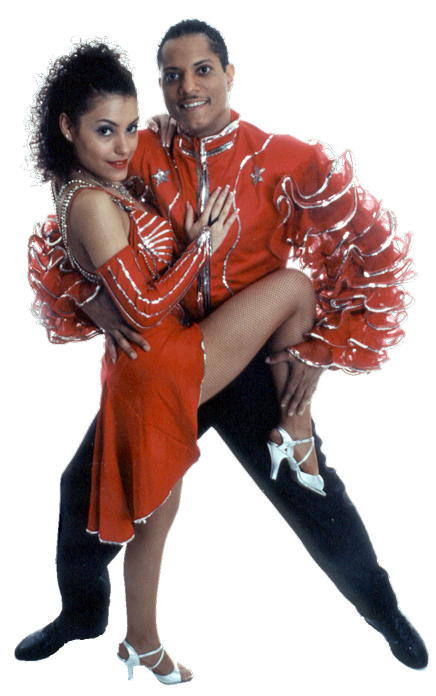
Yesterday was International Dance Day, and Bogota celebrated by having performances in public venues across the city. The group I am a part of--Afrolatina Salsa Show--was invited to perform. It was our first performance as a group, and I think the four-song show went over pretty well. If nothing else, I made it onto the website of Semana, Colombia's leading weekly magazine. Only eleven pictures were posted! The three I appear in are below, original link here.
(And yes, I realize the costumes are a bit flamboyant. Just wait until our mamberos are ready, in which case I'll look more like this guy.)


(And yes, I realize the costumes are a bit flamboyant. Just wait until our mamberos are ready, in which case I'll look more like this guy.)


Tuesday, March 17, 2009
And he's back
I had big plans for this blog—weekly posts, fascinating insights into Colombia, a regular supply of pictures… I’ve definitely come up short on all counts. Nevertheless, I’m recommitting myself to this endeavor, especially as it will force me to take pictures, something I’ve rarely done since arriving.
Luckily, the lack of posts is not due to lack of things to share. Life has gotten busy here in Bogotá. I’m back in student mode again, reading for some classes more than I ever had to do for classes at UNC and undertaking the at times painstakingly slow process of writing papers in Spanish. With only three classes though, I can’t complain, as I still have time to have a life outside of school.
Concert of Santana and Fania All-Stars, including Richie Rey, Bobby Cruz, Andy Montañez, Cheo Feliciano, Adalberto Santiago, Johnny Pacheco, Papo Lucca, Roberto Raena, Bobby Valentín, Ismael Quitana, Alfredo de la Fe, and Luis García
In addition to salsa caleña classes, I am now part of a salsa team, our eyes set on Bogotá’s annual salsa competition in July. My salsa instructors have won the partner category for the past three years, and this is the first time they’ve organized some of their students for the group category. Nice prizes for the winning team, as well as the opportunity to perform in the city’s annual salsa festival in August. We’ll see what happens, but we definitely have a lot of work to do.
I’ve also started volunteering with a great organization called Fundación Niños de los Andes, which runs a variety of programs designed to help street children. I work in the so-called Patrullas de Rescate (Rescue Patrols), in which we carry out a variety of activities in Bogotá neighborhoods that have been identified as problem areas. The activities are designed to promote be awareness of social resources in each community, identify problems specific to each neighborhood, provide medical attention if necessary, and, in some cases, identify children for the foundation’s community homes and rehabilitation programs.
I’m still participating in the research project on ex-combatants, exploring the wealth of Bogotá cafes, getting to know my classmates, etc etc. All in all, life is treating me well. Being called for lunch now, so I better get going. I promise my next post will be a bit more interesting. Happy St. Patrick’s Day!
Luckily, the lack of posts is not due to lack of things to share. Life has gotten busy here in Bogotá. I’m back in student mode again, reading for some classes more than I ever had to do for classes at UNC and undertaking the at times painstakingly slow process of writing papers in Spanish. With only three classes though, I can’t complain, as I still have time to have a life outside of school.
Concert of Santana and Fania All-Stars, including Richie Rey, Bobby Cruz, Andy Montañez, Cheo Feliciano, Adalberto Santiago, Johnny Pacheco, Papo Lucca, Roberto Raena, Bobby Valentín, Ismael Quitana, Alfredo de la Fe, and Luis GarcíaIn addition to salsa caleña classes, I am now part of a salsa team, our eyes set on Bogotá’s annual salsa competition in July. My salsa instructors have won the partner category for the past three years, and this is the first time they’ve organized some of their students for the group category. Nice prizes for the winning team, as well as the opportunity to perform in the city’s annual salsa festival in August. We’ll see what happens, but we definitely have a lot of work to do.
I’ve also started volunteering with a great organization called Fundación Niños de los Andes, which runs a variety of programs designed to help street children. I work in the so-called Patrullas de Rescate (Rescue Patrols), in which we carry out a variety of activities in Bogotá neighborhoods that have been identified as problem areas. The activities are designed to promote be awareness of social resources in each community, identify problems specific to each neighborhood, provide medical attention if necessary, and, in some cases, identify children for the foundation’s community homes and rehabilitation programs.
I’m still participating in the research project on ex-combatants, exploring the wealth of Bogotá cafes, getting to know my classmates, etc etc. All in all, life is treating me well. Being called for lunch now, so I better get going. I promise my next post will be a bit more interesting. Happy St. Patrick’s Day!
Sunday, February 8, 2009
Safety, perceptions of safety, and annoying foreigners in Bogotá
Perhaps the most the interesting statistic related to crime in Bogotá is not that the city is one of the safest metropolises on the continent—though this is true—but rather bogotanos have a much more negative perception about safety in their city than other urban Latin Americans have about theirs. I quickly became aware of this phenomenon when I started to receive safety advice that bordered on the extreme—such as, take a taxi from the Transmilenio station to my apartment at night to avoid walking…a block and a half.
Bogotanos obsession with safety seems to be partially related to their social status. The richer, the more paranoid. In part, I think bogotanos’ extreme safety consciousness involves a class bias, a misunderstanding/lack of understanding of the poor on the part of the rich. However, it goes beyond the upper crust of Bogotá, as evidenced by Rosalba, the woman I live with, one of the most safety conscious of them all. I can only guess that darker times in Bogotá history, when murder and kidnapping rates soared, continue to resonate in the minds’ of bogotanos today.
However, the reality is far better than bogotanos would seem to suggest. Bogotá’s murder rate is half that of DC and pales in comparison to Guatemala City, San Salvador, Rio de Janeiro, Caracas, São Paulo, and Tegucigalpa. Figures for robbery and assault paint a similar picture. In any case, I listen to people’s advice and even if I often scale down their safety assessments in my head, I realize they are well-intentioned.
The intentions of another character I call into question. We’ll call the individual in question Paco, though he is a gringo just like me. Anthony Dest and I met Paco at a friend’s apartment. Paco is halfway through his year in Bogotá, participating in a teacher exchange with a school in a poorer area of the city. Without wasting any time, he explained to us how dangerous his situation was, how horrible some of the stories he’d heard were, and how we probably wouldn’t be exposed to “that Bogotá” because we’re attending a university.
To give us an illustrative example, Paco shared with us his daily bus ride that takes him through the Centro—without realizing that I live in the area he is talking about. It’s maybe not the nicest part of Bogotá, but it’s no scene from City of God. Throughout our (short) conversation, Paco continued to exaggerate without shame. While I have no doubt that Paco has been exposed to a number of the sad realities of Bogotá in the area where he teaches, he pertains to a group of people that loves to hype the dangerousness of their living situation, exaggerating in order to demonstrate to the isolated and insulated rest of us that they are living on the edge.
I think it is important to recognize the issues of conflict that continue to exist in Colombia and affect thousands upon thousands of people each year. A series of bombs set off by the FARC in various cities in the last two weeks serves as a reminder that violence in Colombia has a long history and has not gone away. But, Paco, let’s not pretend Bogotá is in the middle of a war zone. Your exaggerations do not help dispel stereotypes about Colombians held by most of the world and make people like me vent about you in the blogosphere to family and friends.
Now that that’s off my chest, I’ll say that the dynamic of the perceptions of violence and crime vs. the reality of Bogotá is fascinating, especially given the manner in which Colombians, over time, have become desensitized to violence. I am still looking for the answer to this puzzle, and I’ll let you know if I ever figure it out.
Bogotanos obsession with safety seems to be partially related to their social status. The richer, the more paranoid. In part, I think bogotanos’ extreme safety consciousness involves a class bias, a misunderstanding/lack of understanding of the poor on the part of the rich. However, it goes beyond the upper crust of Bogotá, as evidenced by Rosalba, the woman I live with, one of the most safety conscious of them all. I can only guess that darker times in Bogotá history, when murder and kidnapping rates soared, continue to resonate in the minds’ of bogotanos today.
However, the reality is far better than bogotanos would seem to suggest. Bogotá’s murder rate is half that of DC and pales in comparison to Guatemala City, San Salvador, Rio de Janeiro, Caracas, São Paulo, and Tegucigalpa. Figures for robbery and assault paint a similar picture. In any case, I listen to people’s advice and even if I often scale down their safety assessments in my head, I realize they are well-intentioned.
The intentions of another character I call into question. We’ll call the individual in question Paco, though he is a gringo just like me. Anthony Dest and I met Paco at a friend’s apartment. Paco is halfway through his year in Bogotá, participating in a teacher exchange with a school in a poorer area of the city. Without wasting any time, he explained to us how dangerous his situation was, how horrible some of the stories he’d heard were, and how we probably wouldn’t be exposed to “that Bogotá” because we’re attending a university.
To give us an illustrative example, Paco shared with us his daily bus ride that takes him through the Centro—without realizing that I live in the area he is talking about. It’s maybe not the nicest part of Bogotá, but it’s no scene from City of God. Throughout our (short) conversation, Paco continued to exaggerate without shame. While I have no doubt that Paco has been exposed to a number of the sad realities of Bogotá in the area where he teaches, he pertains to a group of people that loves to hype the dangerousness of their living situation, exaggerating in order to demonstrate to the isolated and insulated rest of us that they are living on the edge.
I think it is important to recognize the issues of conflict that continue to exist in Colombia and affect thousands upon thousands of people each year. A series of bombs set off by the FARC in various cities in the last two weeks serves as a reminder that violence in Colombia has a long history and has not gone away. But, Paco, let’s not pretend Bogotá is in the middle of a war zone. Your exaggerations do not help dispel stereotypes about Colombians held by most of the world and make people like me vent about you in the blogosphere to family and friends.
Now that that’s off my chest, I’ll say that the dynamic of the perceptions of violence and crime vs. the reality of Bogotá is fascinating, especially given the manner in which Colombians, over time, have become desensitized to violence. I am still looking for the answer to this puzzle, and I’ll let you know if I ever figure it out.
Friday, February 6, 2009
Los Andes Pics
To celebrate the arrival of my battery charger and USB cable, I'm posting some pictures of Los Andes. A (brief) bit of background info: The university was founded in 1948 to serve the children of the Colombian elite. It's grown from a student body of 79 students in 1948 to more than 13,500 today and is widely regarded as the best university in Colombia. The university offers 28 undergrad programs and 58 grad programs. And, most importantly, our mascot is a goat named Séneca...
(Pictures can be viewed in full by clicking on them.)
Subscribe to:
Posts (Atom)